


Mini Corn Harvester HS-4YZ-1 – 1 Row Self-Propelled Corn Harvester with Bagging Collection
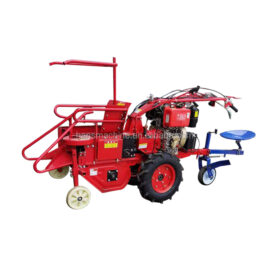
The HS-4YZ-1 is a mini corn harvester for growers who work small, fragmented or ridged plots that a full-size combine can never enter. It picks one row of corn, sends the ears up a conveyor into a bag-ready collection box at the rear, and chops the stalks back into the soil in the same pass. Power comes from a 195F diesel engine with electric start, rated 9.2 kW (12.3 hp), and the machine weighs 280 kg. This page lists the full factory specification, the working parameters and the tyre options. If you are still comparing models, our mini corn harvester buying guide sets out the specification numbers that decide whether a small machine suits your plots.
A Small Corn Harvester Built for Plots a
Combine Cannot Enter
Most corn is not grown in fields a self-propelled combine can reach. On fragmented holdings the rows are short, the headlands are tight, and the gap between two rows is often too narrow for a machine with a wide header. Hiring a combine is not realistic at that scale, and a hand crew has to be found and paid exactly when the crop is ready — a window measured in days, not weeks.
The HS-4YZ-1 is sized for that reality. It measures 2,200 × 950 × 1,200 mm and weighs 280 kg, so it travels on a small trailer and can be walked into a plot through a gap a tractor cannot use. Because the operator walks behind the machine instead of sitting on it, the working position stays close to the crop, which matters on narrow terraces and ridged beds where visibility from a cab is poor. One person starts it, runs it, loads it and stores it.

Bagging Collection at the Rear: How the Ears Reach the Bag
On a hand-picking crew, a large share of the labour is not picking at all — it is walking the rows afterwards to gather what was picked. The HS-4YZ-1 removes that step by bringing the crop to the operator instead of sending the operator back through the field.
The picking header takes the ear from the stalk, and a conveyor carries it to a collection box at the rear of the machine. That box is bag-ready, so the ears arrive in one place and the sack is filled, tied and set aside without leaving the working line. Collection and storage become one motion rather than a second pass over the same ground, and the ears never rest on the soil where they pick up dirt and moisture. For fresh-market and seed growers the difference shows up in the condition of the crop that reaches storage, not only in the hours saved.
Three Jobs in One Pass: Picking, Collection and Straw Chopping
Picking the ears is only part of a harvest. Stalks and leaves still have to be cleared before the next crop, and on small plots that job is normally done by hand or with a separate chopper pulled through the field a second time.
The HS-4YZ-1 carries twelve blades, each 80 mm long, that chop the stalks and return them to the soil as the machine moves down the row. Three operations — picking the ears, collecting them into the bag-ready box, and chopping the straw back into the field — happen in a single pass. One pass means one set of wheels on the ground and no second machine to rent. Returning the chopped straw also puts organic matter back into the soil instead of leaving it to be burned or hauled away, which is restricted or discouraged in a growing number of markets. Keeping the work to a single pass also means fewer wheels over the same ground, which matters on plots where the soil is already worked by hand.
Power and Control: 195F Diesel with Dual Differential Steering
The engine is a 195F single-cylinder diesel with electric start, rated 9.2 kW (12.3 hp). A diesel of this size makes its torque low in the rev range, which is what a picking header needs when the crop is dense or the ground is uneven. Electric start matters more than it sounds: in a field, hand-cranking a cold diesel is a job nobody wants to repeat, and one turn of the key is often the difference between a machine that gets used every day and one that stays under a tarpaulin.
Steering is handled by a built-in dual differential, so the two sides of the machine rotate at different speeds and the inner wheel slows rather than being dragged around a locked axle. Headland turns become tighter and need less operator effort. The main clutch is a wet type running in an oil bath, which tolerates the repeated engagement of start-and-stop headland work far better than a dry clutch, and drive is transmitted by gears rather than belts.
Full Technical Specifications
Every figure below is taken from the factory specification sheet for the HS-4YZ-1, and every unit is built to the same drawings; the hp and mm values are unit conversions of the sheet’s kW and cm figures. The numbers worth checking first are the row count, the overall width and the mass, because those three decide whether the machine fits your plots and how you will move it between them. If you are unsure how to read them against your own land, send us your row spacing and we will confirm.
Tyre Options and Working Parameters for Ridged Land
Standard tyres are 400-8 solid. Solid tyres are the practical default in stubble: there is no tube to puncture and no pressure to check before a working day. For growers on ridged beds or in softer ground, two options are available from the factory — 400-10 solid tyres and 500-10 pneumatic tyres. Pneumatic tyres spread the load over a larger footprint, which is the usual choice when the surface is soft or the beds are raised, which is why ridged plots can be worked with the optional set.
The machine works at 0.3 m/s or above with an ear intact rate of 95% or better. Those two figures are the ones worth asking about on any small harvester, because they describe what actually reaches the bag and what is left in the field. Intact rate covers ears that arrive whole rather than cracked or stripped, and on a picking machine that figure is decided by how gently the header and the conveyor handle the ear between the stalk and the collection box.
Frequently Asked Questions
What engine does this mini corn harvester use? A 195F single-cylinder diesel with electric start, rated 9.2 kW (12.3 hp). Electric start means no hand-cranking in the field.
How many rows does it harvest? One row. The machine is designed for small, fragmented and ridged plots rather than large flat fields.
How are the ears collected and bagged? The header picks the ear and a conveyor carries it to a bag-ready collection box at the rear, so the crop arrives in one place to be sacked.
Does it chop the straw as well? Yes. Twelve blades, each 80 mm long, chop the stalks and return them to the soil in the same pass as picking and collection.
Can it work on ridged or hilly land? Yes. Optional 400-10 solid or 500-10 pneumatic tyres are available for ridged beds and softer ground.
What is the working speed and the ear intact rate? Working speed is 0.3 m/s or above and the ear intact rate is 95% or better, from the factory specification sheet.
What are the dimensions, weight and packing size? The machine is 2,200 × 950 × 1,200 mm and 280 kg; packing size is 1,460 × 770 × 1,000 mm per unit.
How is it shipped and supported? Each unit is packed at 1,460 × 770 × 1,000 mm. Send us your container size and we will provide a loading plan, together with the spare-parts list and the commercial terms for your order.
Ordering, Packing and Support
Machines are packed as single units at 1,460 × 770 × 1,000 mm, so the loading plan depends on the container you book rather than on a fixed number per box. Send us the container size you intend to use and we will return a loading plan, so you know the freight cost before you commit to a quantity.
If you are a grower, tell us your row spacing, plot size and ground conditions, and we will confirm whether the HS-4YZ-1 or a larger machine is the better fit for your land. If you are a dealer or importer, send your target market, order quantity and destination port instead, and we will quote the machine with a spare-parts list so the first order covers the parts your customers are most likely to need.
Pricing, warranty terms and spare-parts packages are confirmed on the quotation for your specific configuration and destination, so there is no ambiguity after the order is placed. Moulded-part production keeps the machines consistent unit to unit, which means the spare that fits one machine fits the next one in the container — worth confirming early if you plan to hold stock for a dealer network.